For many existing SAP® customers, an important deadline is drawing closer:
Regular mainstream maintenance for core applications of the SAP Business Suite 7® will expire at the end of 2027. Paid extended maintenance is planned for certain solutions until the end of 2030. (SAP Support Portal)
For many companies, the consequence therefore seems already clear:
We have to switch to SAP S/4HANA. But is that really true?
A switch from SAP ERP or SAP ECC to S/4HANA® is no ordinary update. It can be an extensive transformation project that ties up significant internal resources, changes processes, and requires high investment.
Therefore, a fundamental question should be answered before starting:
Is S/4HANA® actually the best solution for our company?
Or would it be economically and strategically more sensible to re-examine the market?
Many companies merely compare different paths to S/4HANA® migration:
🔹 Brownfield 🔹 Greenfield 🔹 Selective Data Transition 🔹 On-Premises 🔹 Private Cloud 🔹 Public Cloud
What is often missing is the most important alternative:
The open-ended selection of a completely new ERP system.
After all, anyone who has to analyze processes, clean data, check interfaces, evaluate custom developments, and provide significant project budgets anyway should not automatically assume that the current vendor is also the best choice for the next ten or fifteen years.
A migration is not automatically cheaper than a new implementation
At first glance, staying with SAP® appears to be the safest and easiest path.
But the actual costs do not only arise from software licenses or cloud subscriptions.
The following must be taken into account, among other things:
- Technical migration and system conversion
- Adaptation or replacement of existing custom developments
- Revision of interfaces
- Data migration and data cleansing
- Process harmonization
- Testing effort
- Employee training
- External consulting
- Internal project resources
- Operating and infrastructure costs
- Future license and maintenance costs
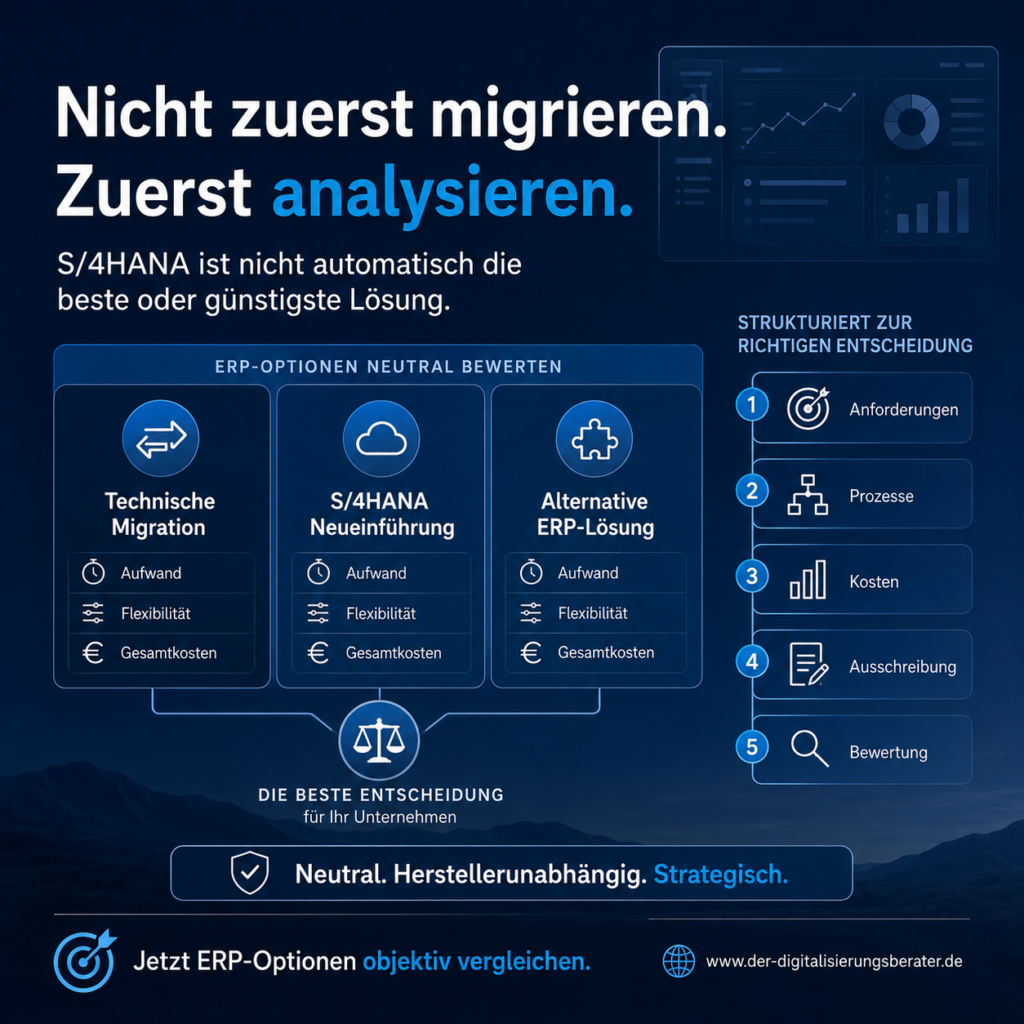
Don’t migrate first. Analyze first! Image: ChatGPT
In addition, there is a crucial question:
How much of today’s SAP system is actually still needed and how much complexity has been built up over decades?
A modern ERP solution from another provider could potentially:
1. Fit today’s business model better functionally
2. Enable processes closer to the standard
3. Be implemented faster
4. Be easier to use
5. Result in lower operating and license costs
6. Offer more flexibility for future changes
This is not necessarily the case. But it should be checked.
Not SAP® against the rest, but the potential solution against current requirements
Because: A neutral ERP selection must not begin with the desired result.
The correct sequence is:
- Define business goals and future requirements
- Analyze current processes and system problems
- Prioritize necessary functions
- Compare realistic total costs
- Tender for suitable providers and solutions
- Objectively evaluate S/4HANA® and alternative ERP systems
Only then should it be decided whether:
- A technical SAP® migration,
- A largely new S/4HANA® implementation,
- Or the switch to another ERP provider
Brings the greatest economic and strategic benefit.
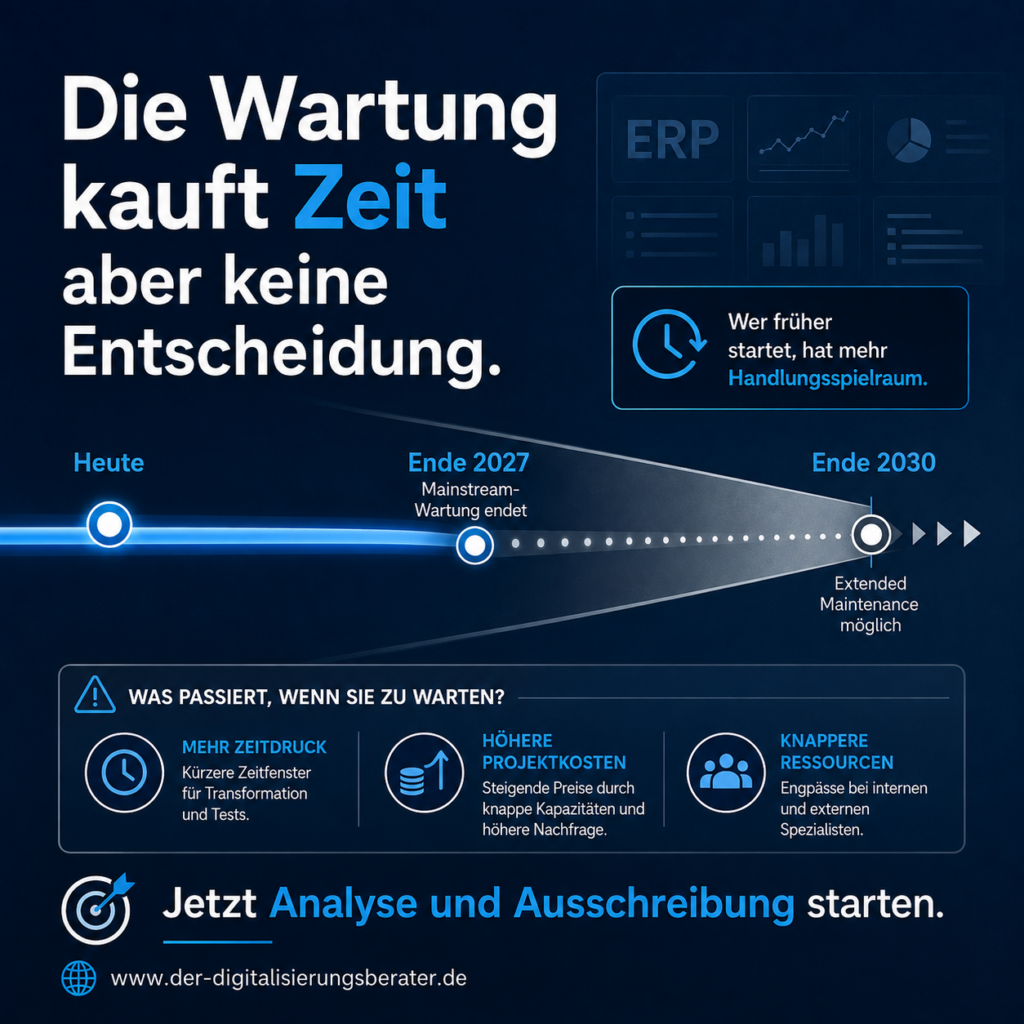
Maintenance buys time but not a decision! Image: ChatGPT
Extended maintenance buys time but not a decision!
The existing system will not suddenly stop working after the end of mainstream maintenance.
However, without a suitable maintenance and support strategy, risks increase: for example, due to missing regular updates, limited further development, new legal requirements, security issues, and the increasingly difficult availability of suitable specialists.
The optional extended maintenance until the end of 2030 can create additional room for maneuver. (SAP Support Portal)
But it is no substitute for a long-term ERP strategy.
And it does not answer the crucial question:
Is SAP S/4HANA® still truly the best and most economical future solution for your company?
Analyze now: before time pressure dictates the decision
A sound ERP selection and implementation takes time.
The later companies start, the smaller the room for maneuver becomes. At the same time, the risk increases that decisions will be made under deadline pressure and available consulting and implementation resources will become scarcer.
That is why now is the right time for an independent analysis and tender.
Not with the goal of necessarily replacing SAP®.
But with the goal of obtaining a reliable answer:
What is functionally, economically, and strategically the best ERP solution for our company?
As a neutral digitalization consultant, I support companies in
- Determining actual requirements,
- Comparing SAP S/4HANA® with suitable alternatives,
- Evaluating realistic total effort and costs,
- Conducting a vendor-neutral tender,
- And preparing the right investment decision.
Because an ERP decision of this magnitude should not be made solely because the current provider dictates a technological change.
Use the necessary pressure for change for a real market review.
More information: www.der-digitalisierungsberater.de
Where does your company stand today?
Has the switch to S/4HANA already been decided, or is it still being checked in an open-ended way whether another ERP solution would be better and even cheaper in the long run?
This is exactly where we can help you with our methodology, tools, and 40+ years of experience.
Just get in touch. It will certainly be worth it!
#SAP #S4HANA #SAPMigration #ERP #ERPSelection #ERPProject #Digitalization #DigitalTransformation #SoftwareSelection #Mittelstand #ITStrategy #EnterpriseSoftware
Always be the first to receive the latest news, interviews, and expert articles?