…and how to find the best solution for your company.
Transport management systems have evolved significantly in recent years.
Dispatching, route planning, telematics, freight management, sales, and fleet management have now reached a very high level in many TMS solutions.
However, one area keeps standing out: Procurement often exists only in a rudimentary form—or not at all.
And that is becoming a real problem for many freight forwarders.
The blind spot of many TMS systems
In many companies, operational procurement still runs like it is the Stone Age, e.g.:
- via Excel
- via Outlook
- by phone
- with individual lists
- or via standalone solutions outside the TMS
We are not talking about side issues, but about core processes that all logistics service providers must cover, such as:
- tenders that are not transport-oriented
- contract management, leasing, rentals, etc.
- purchase requisitions and approvals
- requests and purchasing of consumables such as tires and spare parts
- requests and purchasing of project-related services and items (e.g., for warehouse construction)
- requests and purchasing of services such as consulting
- ready-made KPI analyses
- forecast planning across all relevant areas
- integrated AI functions that support procurement
- document management and review
- compliance and certificate management
and much more.
Why has procurement been neglected for so long?
The answer often lies in the history of the systems.
Many TMS solutions were originally developed for:
- dispatchers
- operational transport execution
- route control
- shipment management and tracking
The focus was on: “How do I get the goods transported?”
Not on: “How do I manage my ENTIRE procurement strategically and operationally?”
The result: Procurement was often viewed as a “side system”, even though this is where there is now massive cost and margin potential.
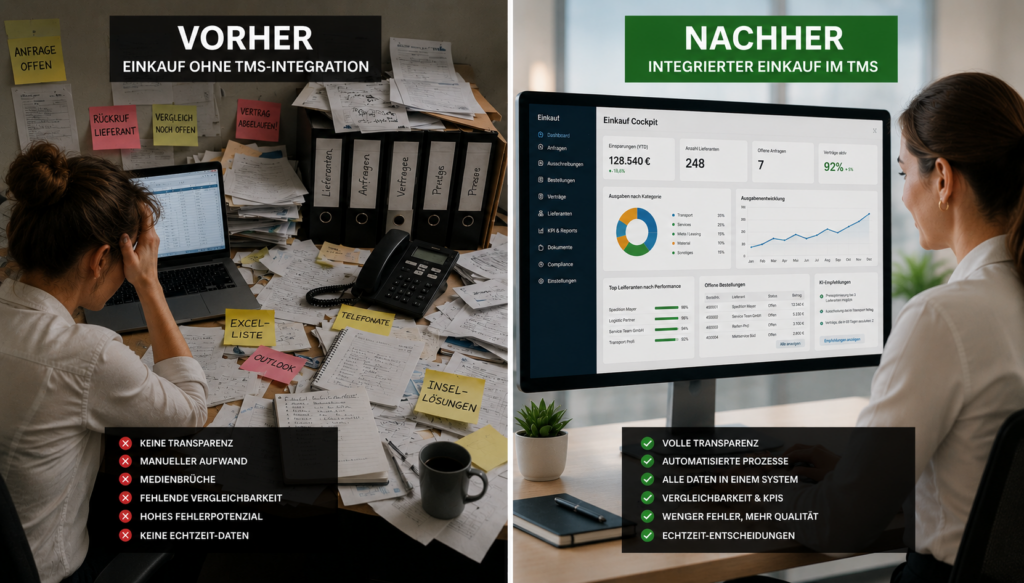
The freight forwarder without and with digital procurement
The reality in many freight forwarding companies
Many companies now work with real process breaks:
- Sales calculates prices in the CRM or TMS
- Dispatch assigns transports in the TMS
- Procurement manages service providers in Excel
- Accounting checks invoices separately
- And controlling then laboriously tries to consolidate the data
- Contracts and documents are managed in a partially integrated DMS
This leads to:
- a lack of transparency
- poor comparability of costs that are not transport-based
- media discontinuities
- high manual effort
- lack of transparency in margins
- a lack of procurement strategy
- slow or error-prone tendering processes
- higher overall risk of errors
etc.

Are you also searching in vain for the procurement module in the TMS?
Why this topic is becoming critical now
The market is changing.
Rising transport costs, volatile freight rates, driver shortages, and increasing competitive pressure are forcing companies to professionalize their procurement processes.
In addition, there are new requirements such as:
- ESG and sustainability evidence
- supplier evaluations
- digital tenders
- real-time price comparisons
- AI-supported procurement decisions
- automated awarding processes
Without integrated procurement, many TMS landscapes are reaching their limits.
The real problem: a lack of an overall strategy
Many companies are now trying to close the gap with additional tools.
But that is exactly how new standalone solutions emerge.
The key question therefore is not: “Which additional procurement tool do we need?”
But rather: “How do we integrate procurement, dispatch, sales, controlling, and operational processes into a shared system strategy?”
Because procurement is not an isolated process.
It directly influences:
- contribution margins
- service quality
- delivery capability
- margins
- customer satisfaction
- Scalability
The future of the TMS
The next generation of modern TMS solutions will no longer just manage transports.
It must:
- integrate end-to-end procurement
- use AI for awarding decisions
- evaluate service providers and suppliers
- identify risks
- digitize tenders, regardless of product or service
- consolidate operational and strategic data
Only then will a truly end-to-end digital transport platform emerge.
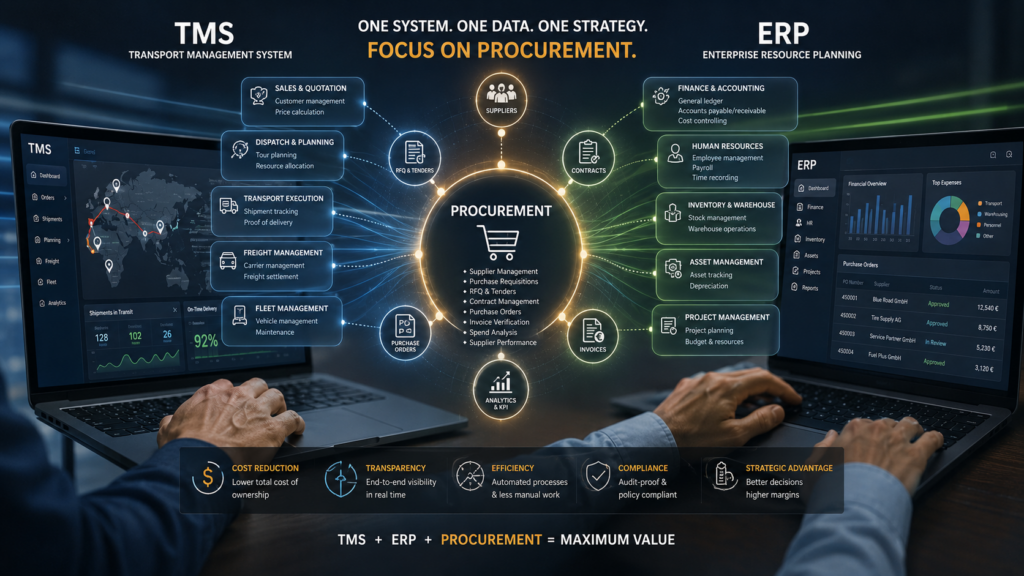
ERP/WMS with a procurement focus for logistics providers
Always be the first to receive the latest news, interviews, and expert articles?
Conclusion: Many freight forwarders today do not suffer from a lack of dispatch technology.
They suffer from a lack of procurement integration.
And that is exactly where there is often enormous potential:
- lower costs
- better transparency
- higher margins
- less manual work, more automation
- better scalability
- more professional supplier management
Procurement has long since ceased to be a side issue in transport management.
It is increasingly becoming a strategic success factor.
So the question is no longer: “Do we need procurement functionality in the TMS?”
But rather: “How much longer can we keep working without it?”Start of form
Would you like to find the best procurement solution for your company? No problem. As a consultant, I know hundreds of potential providers. Depending on your TMS, requirements, and industry, we will find the ideal solution for you—ideally as part of an overall digitalization strategy.
Leverage my 40+ years of experience and benefit from it in your own company.
You can book a free initial appointment here via the link.
Image source: ChatGPT