Real vs. Fake Cloud Software: How to Protect Your Company from Deceptive Packaging
Introduction: The Cloud-Washing Epidemic in the Enterprise Sector
In today’s IT strategy consulting, we encounter a dangerous phenomenon: the inflationary use of the term “cloud.” Almost every software provider is currently pushing aggressively into the market to appear modern and future-proof. The promise is always: “We are cloud-native.” Yet, behind the shiny facade of many marketing brochures often lies a technological deceptive package.
For you as a decision-maker, distinguishing between true cloud architecture and mere “cloud-washing” is not just a technical detail—it is the foundation of your digitalization success. Those who invest in the wrong architecture today are buying tomorrow’s legacy burdens. A wrong decision in this area inevitably leads to a technological dead end that paralyzes your agility and destroys your return on investment (ROI).
The Architecture Trap: Why Cloud-Washing Endangers Your ROI
By “Fake Cloud,” we mean existing on-premise software that has merely been moved to a remote server without any fundamental changes to its code base—a process strategists refer to as “lift & shift” or simple hosting. These legacy systems were never designed for the cloud and therefore cannot exploit its economic potential.
Providers often use fake cloud models out of pure marketing pressure to avoid the high costs of a true new development. The signs of such systems are clear:
- Rigid hosting models: The software runs in isolated instances per customer, which prevents efficient resource utilization.
- No automated scaling: Since the architecture is not modular, peak loads cannot be handled dynamically; manual intervention remains necessary.
- Outdated web facades: Often, a web interface has simply been placed over an old desktop application, which massively restricts interoperability (APIs).
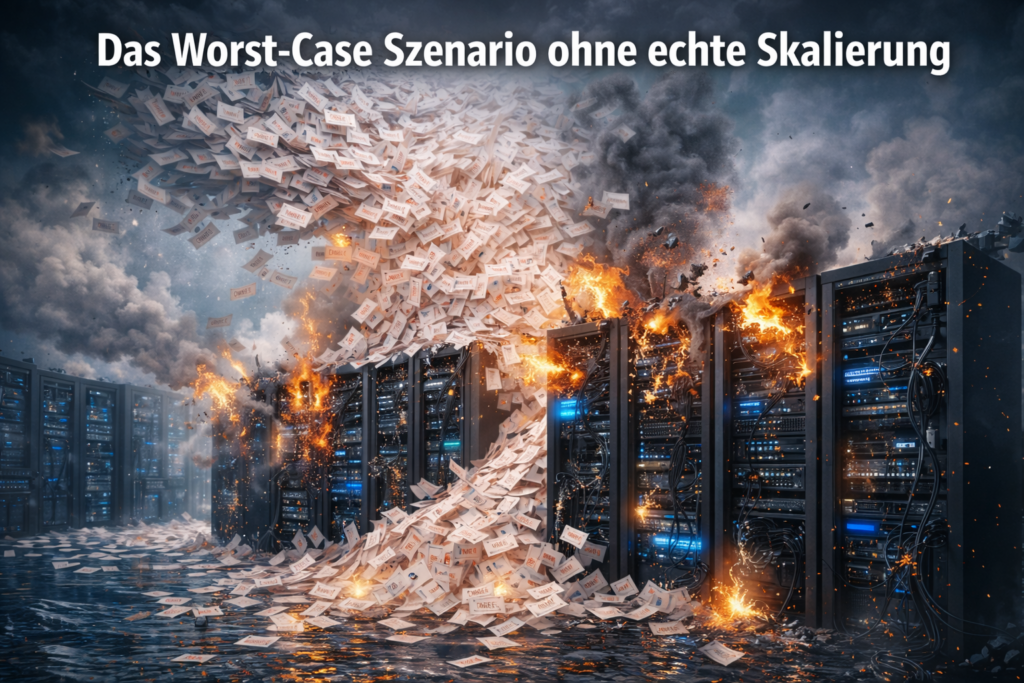
Fake clouds are often difficult to scale
Checklist: How to Unmask Fake Cloud Providers
Use this strategic checklist to critically dissect software offers during the selection process. A “no” in these areas usually means a linear scaling of your costs as the number of users increases.
- [ ] True Multi-Tenant Architecture: Do all customers share a logical software instance and the same code base?
- Consequence: If not, your maintenance costs and security risks increase individually with every update.
- [ ] Automated, Elastic Scalability: Can the software immediately scale resources such as computing power and storage up and down without manual intervention?
- Consequence: A lack of elasticity leads to performance bottlenecks and prevents modern pay-per-use billing.
- [ ] Centralized Release Management: Do all customers receive updates and new features simultaneously and fully automatically?
- Consequence: Individual update cycles tie up resources in your IT and prevent rapid access to innovations.
Ask the provider these targeted “trick questions” during the sales pitch:
- “Is your solution based on a multi-tenant architecture, or do you operate an isolated single instance in a virtual machine for us?”
- “How do you technically ensure that a sudden tenfold increase in user load is handled within minutes without manual administrator intervention?”
- “Can we guarantee that we will be working on the latest version on day one of every release, without the need for migration projects on our side?”

Filter out the fake providers from your proposals
Always be the first to receive the latest news, interviews, and expert articles?
The Advantage of True Cloud Technology
True cloud software is the mandatory prerequisite for using proven methods of modern digitalization, such as CI/CD (Continuous Integration/Continuous Deployment) and agile scaling. Only a cloud-native architecture allows your company to roll out innovations in weeks instead of years. This massively reduces the Total Cost of Ownership (TCO), as manual maintenance efforts and expensive infrastructure reserves are eliminated.
True cloud software offers you a decisive competitive advantage through maximum technological agility and minimum operating costs, as it realizes economic economies of scale through multi-tenancy and automated scaling that are technically impossible with hosted legacy systems.
Those who rely on true cloud architecture invest in a future-proof platform that secures your company’s digital lead in the long term through immediate innovation availability and seamless API connectivity.

Benefits are only available with the real cloud
Conclusion
In IT strategy, the rule is: quality comes before marketing promises. The choice of the right architecture determines whether your IT is an innovation engine or a cost block. Technically speaking, a fake cloud solution is a step back into the era of classic hosting, disguised as a modern service. Protect your company from these deceptive packages by demanding technical excellence and true multi-tenancy.
For more in-depth advice and support in selecting your future software architecture, visit us on our website: www.der-digitalisierungsberater.de. We accompany you in achieving a real digital advantage through the use of proven methods.
Image source: ChatGPT