Or: Dependency is fun! (just not for the dependent)
It is depicted in the most vibrant colors. You are supposed to feel like you’re on “cloud nine”. If, yes, if you subscribe to a cloud solution.
It is supposed to be simpler, more secure, more cost-effective, and simply more future-proof.
But wait, where are the pitfalls one can stumble into? Are there any, or has sales once again only spouted the “truth and nothing but the truth”?
Could it be that for some, the big awakening only comes when things go seriously wrong? Let’s take a look.
I dedicate this blog post to a topic that remains highly explosive. At least from my perspective.
A topic that many already consider “the new normal” and for which, for many, there are “no alternatives”.
But is that really the case, or if one uses it, shouldn’t one incorporate some “safeguards”?
It’s going to be exciting again!

Floating on the Software Cloud. Falling will hurt!
I know, as a digitalization consultant, one should always approach these modern technologies openly and even promote them in the interest of the user (company). But those who know me are aware that as a constant “questioner,” I keep a critical eye on all relevant and even seemingly less relevant topics in the interest of my clients. And usually, something comes out that many would rather not have seen.
But let me say this upfront: For “almost” all critical questions, there are also solutions. At least if the providers want them. (which, unfortunately, is not always the case)
But first, a look back. Where does the cloud actually come from?
Everyone associates the cloud with the internet, software that runs on the internet, i.e., in a web browser.
There are different types of cloud solutions, such as the Public Cloud or a Private Cloud, etc.
However, that is not our topic.
What connects all these solutions is that you no longer install significant hardware in your own premises, and everything runs centrally.
Ideally, several clients/companies are “processed” on one large system.
And when is the propagated cloud actually just a “fake” cloud?
Not all clouds are created equal. Some simply call it that because it sounds more modern. As soon as one speaks of, for example, VM-Ware or virtualization, it is nothing other than the long-known “data center.”
If you “virtualize” and use a “fat client” (not a web browser), then it is not a true cloud solution in the traditional sense.
So, be careful not to be fooled. That is already the first pitfall.
Americans would say in this case “lipstick on a pig” or “new paint on an old car,” because the technology must also fit.

Well-tolerated or long-term “toxic”? The software in the cloud
The Top Risks of the Cloud
Top I – How do I get my data back?
I once wrote a specialist article on the topic “What happens to the data after the divorce, with the cloud.” (Link here)
Because almost everyone seems to forget one thing. A “good” time can sometimes come to an end. And then what?
How do I really get my data back?
Getting a complete copy of the database is rather unlikely, because either other customers are also in the same database (then I can hardly “get” the data) or the database is so complex to manage and has such high requirements that I simply don’t want it.
Furthermore, few providers are willing to release their complete database structure externally. Especially since you are no longer a customer then.
We can pretty much rule out this option.
A database export in ASCII or Excel, corresponding to the individual files in the database and documented as such (links, dependencies, key fields, data dictionary, etc.), with which I can then easily start an import into a new system.
The problem: I have not yet seen any system that provides this in this environment and with the corresponding documentation.
2 Case Studies on “Getting Data Back”
Case I
As a test user of the world market leader in CRM applications (who might that be?), I allowed myself to have a data backup made.
It arrived. Via email (yes, you read that correctly) in Excel files (which would still be acceptable), but with partly cryptic field names and without any information on how the tables were linked to each other. (Example: order header data, order item data, order footer data).
I was “forced” to deduce what was what based on the data content. In the case of the small amount of data, this was still possible. Imagine if I had used the system extensively and had a ton of data in it. The ultimate disaster!
The absolute worst, however, was that ALL my file attachments were simply delivered in a “ZIP file.” Without any information about which record they were previously attached to!
Clarification: This was several years ago, but it still begs the question for everyone whether this is the format in which one receives their data from a provider?
Case II
During my consultation, the “market leader” for procurement solutions, docked to the “world market leader” for ERP solutions, was asked how and in what format we could get the data back in case of a “divorce.”
The answer was clear and easy to understand: “NO idea.” Even after repeated inquiries, no one in the company could answer this question. Apparently, we were the first to ask it.
Regrettably, the customer (a multinational billion-dollar corporation) still signed the contract. Well, let’s hope it worked out if needed.
Always be the first to receive the latest news, interviews, and expert articles?

Sometimes, when it comes to costs, apples are indeed sold for oranges.
Top II – User Prices, Storage Prices, Price Increases, and Termination
Many systems offer different types of users (Basic, Premium, Development, etc.). But which user do you really need? Here’s a possible trick: simply place a few functions that are needed even with “minimal use” into a higher user profile.
Isn’t it nice that if you get another “unpleasant” price increase, you can, as contractually assured, terminate?
But then what?
Well, first, the aforementioned issue of data backup comes into play. If you haven’t arranged that, you have, as described, a not-so-small problem.
Because as a customer, you are helplessly exposed to price increases. No complaining or other expressions of suffering will help; you just have to go through it.
And due to the created dependency, this is more than questionable anyway. The “world market leader” in operating systems and office products has already proven this with a hefty price increase. You can only pull out your wallet and pay.
If one had “installed” software, one could certainly terminate the maintenance contract. With true cloud solutions, however, this is not possible. There, the price, as legally required for a rental item, is “all-inclusive.” This means: all or nothing!
Well, let’s hope your company will NEVER be in a position where it needs to save money, because here you can only save by using fewer users. But only at the end of your own termination cycle.
As for storage costs, some people are in for a rude awakening. Because who thought that storage space with cloud solutions costs next to nothing anymore (I get 1 TB of pure storage data from my hoster in Germany for approx. €6 per month, i.e., €72 per year)?
With business applications, it reaches completely different heights. An ERP provider stated in 2021 that they would like approx. €60,000 per year for a mere 2 terabytes. A tiny price difference.
Anyone who diligently saves documents, images, even videos, and the like will soon experience their “rude awakening.” Or rather, the “red one,” when the finance department applies the red pen to the bill.
By the way, anyone comparing costs should always create a 10-year calculation. With ALL costs, including foreseeable price increases. Then it would also be good to define the adjustment screws that can be turned when money becomes tighter. This is not so easy with cloud solutions.

Let’s take a closer look at the T or Terms again!
Top III – Terms and Conditions and Rights
Honestly: who actually reads all the TCs or Terms of Service when acquiring a cloud solution?
I dare say almost no one does. And if they do, they tell themselves “I can’t change it anyway” and sign.
Sure, you can do that. But is it really good, and are you acting in the interest of the company and your own rights? Hardly.
One must distinguish whether one is talking about the conditions of a local, possibly owner-managed software company or of market leaders like Microsoft, SAP, or Salesforce, etc.
Anyone who thinks there is much to “negotiate” is mistaken. With the “big players,” especially if you are a “small one,” it’s at best “eat or die.”
Generally, you just have to decide for a YES or a NO. There is usually no room in between. In any case, however, you should read them through. Otherwise, you can only say “I didn’t know.” But that doesn’t help you in case of a problem.
The fact is that almost all “readers” are overwhelmed by the content and then simply “hope” that it won’t be so bad.
But as a rather nice book title from sales says, “hope is not a strategy!”
The TCs usually have a lot in them. Generally, they consist of more obligations than rights. Which is “normal” for contracts. (at least for the buyer).
In addition, they often contain more than questionable “rules” that can often be considered brazen, immoral, or even illegal. An example of this is Microsoft’s new TCs, which give them the right to simply terminate an account in case of “misconduct” (defined by them and the WHO).
(See blog post)
Other TCs have more than “peculiar” clauses. For example, Amazon has a “Zombie Clause” in its Service Terms. Yes, you read that correctly. If zombies take over the world due to an apocalypse and eat human brains, there is no longer any warranty.
One wonders if this is a coincidence, a joke, or if Jeff Bezos (oops, now everyone knows what I’m talking about) knows more than we do. The fact is that this clause has now “disappeared.”
Much more important, however, is that the terms were simply exchanged online. You search in vain for the history. Therefore, you should never rely purely on online documents, but always save them for yourself. Because even one or two words in the text, changed without information, can have quite devastating effects on you.
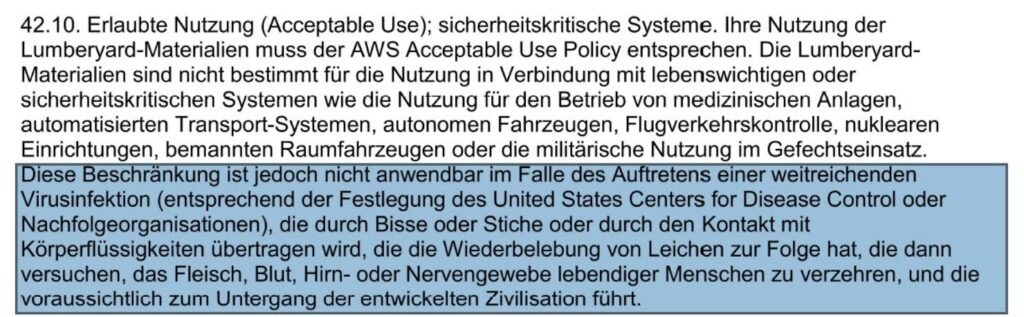
The Proof: The Vanished Zombie Clause
Top IV – Data Storage and Third-Party Access
Good old data protection. No question, the highly modern data centers of large providers are initially much more secure against external attacks compared to an in-house installation within a company.
The shutdown of entire companies is probably rather unlikely here, especially in conjunction with associated blackmail. “Bitcoins or you’ll never get back into your system.”
However, what should not be underestimated is who else has access to the data. For example, government agencies, such as the Americans based on the so-called “Patriot Act.” This allows quite a lot of “access” if they believe it is necessary in the interest of the USA. The NSA is happy about all customers of US-American cloud providers, because it is particularly easy there.
If it has to be cloud, then at least a German company, one might say. Unfortunately, this is not possible with many providers, because you cannot simply choose the hoster yourself, but must take what the provider offers.
Another potential danger for your data would be a possible sale of the provider. Imagine Microsoft being sold to a Chinese company. (Never say never). What then? At the latest then, everyone would go crazy and want their data back. Which brings us back to point I.
A vicious circle!

Changes, whether you want them or not
Top V – Changes/Innovations
Imagine reaching into your closet in the morning and suddenly realizing you’re only wearing “high-water pants.” A brownie must have been there overnight and simply shortened them. Just because someone decided it was the new fashion and everyone who owns pants MUST wear them.
How big would the outcry be? The culprit would quickly be unmasked, and new pants acquired.
With cloud software, however, this often doesn’t work. Because, true to the motto “one size fits all,” a solution is imposed on everyone. This includes the corresponding updates. And because everyone gets them, I can no longer control it.
Of course, certain functions can be configured, but never all. Some cloud solutions also allow the integration of customizations. But often only to a limited extent. So it would be smart to inquire beforehand what else the tailor might come up with and what influence you still have.

The Emergency Plan – Better than Resuscitation
Top VI – The Emergency Plan
Hard to believe, but almost no company has an emergency plan. Yet it is constantly propagated that power outages may occur soon. Sure, then the PC won’t work either, but it’s also enough if the excavator cuts the line and the power is still on.
What then?
Can a company still exist without a running cloud solution? As a rule, certainly not. Because there is no emergency plan, not even emergency 5G phone cards in the system, with which at least some users can continue to use the phone network instead of the wired internet.
One should really think about that.
One thing is certain, however: no general advice can be given here. Because every company works differently. An individual solution must always be developed here. Anyone who doesn’t do that should be reprimanded!

Is your own “way out” known?
There is always a way out (though often only partially) – some tips on the topic of cloud
a.) Read and understand the TCs to know what you’re getting into
b.) Check the data backup method and define it contractually
c.) Regulate price increases or understand them so you know what can happen
d.) Calculate 10-year costs in a price comparison
e.) Check user downgrades and regulate where possible
f.) Choose a local hoster if possible (if there’s a choice)
g.) Clarify customization options and automatic changes
h.) Define an emergency plan for line breaks, both technically and manually
Conclusion:
Cloud solutions often promise the “moon and stars,” but they come with many pitfalls.
For some, they may be exactly right; for others, only with appropriate safeguards; and for a third group, not at all.
So, before you “strike” and let yourself be swayed by great stories, you should ask yourself the questions raised here and then decide.
If you are now a little bit uncertain and would like support with analysis and individual suggestions for eliminating pitfalls, you are welcome to request a free initial consultation here. I look forward to our conversation.
Examine carefully before committing forever! (otherwise, it will be unpleasant and expensive)
Image sources: Shutterstock, Unsplash, AWS