Digitalization and AI. Today with the thesis:
Custom development is dead. Long live AI-based custom development
Why the possible death of traditional software development is not a tragedy, but the beginning of a new era in which custom solutions and standard solutions ultimately converge.
AI & Development
Once upon a time, software development meant: months of requirements analysis, thick specification documents, teams of developers, multi-year projects, and ultimately a system that was already half obsolete upon delivery.
Welcome to the world of traditional custom development.
Then came the era of “agile development.” Fast and in small increments. Unfortunately, often in chaos and with costs no one had anticipated.
But what comes next? Now that AI is more than just “on everyone’s lips”?
These times appear to be over. Not because custom development as a concept has failed, but because in its previous form it is simply no longer competitive.
What is replacing it is something more fascinating: a new generation of custom software that emerges faster, cheaper, and more adaptively than ever before with AI support, while seamlessly integrating with proven standard solutions.
“The code was never the goal. The goal was always the solution to a specific business problem.”
A statement that is more relevant today than ever
The possible end of an era and why we should not mourn
Traditional custom development had its price. Not just financially. Although six- to seven-figure project budgets for medium-sized applications are not uncommon, but also in terms of time and organization. Average project durations of 18 to 36 months in a world that changes on an annual or even quarterly basis are simply anachronistic.
When so-called agility arrived, there were smaller, functional “increments.” Nevertheless, it took time until the final result was available.
The traditional model still had its purpose: Those who needed a highly specialized system that no standard product could provide had no alternative.
ERP, WWS, or WMS systems (just as examples) never fit 100% to one’s own processes. Industry-specific workflows remained stuck in the generic. The gap between “what the system can do” and “what the company needs” was bridged through expensive customization projects, Excel jungles, or workarounds.
Especially when one wanted to develop a competitive advantage from it.
☹ Traditional Custom Development
—18–36 months, or very long project duration
—High initial costs, rigid budgets
—Waterfall or cumbersome agile cycles
—Loss of know-how with personnel changes
—Technical debt often from the start
—Changes after go-live expensive and slow
😊 AI-Based Custom Development
+Weeks instead of months for initial versions
+Significantly lower development costs
+Continuous, iterative approach
+AI assistants document implicitly
+More modern technology decisions through LLM support
+Refactoring and adaptation fast and affordable

Like in New Orleans – celebrating what is to come!
What AI can truly change in software development!
It would be naive to believe that AI “simply writes code.” What actually happens is more subtle and profound: AI assistants like GitHub Copilot, Claude, Cursor, or similar tools fundamentally change the productivity curve of developers.
Studies show that experienced developers with AI support deliver productive code 30 to 55% faster. For less experienced developers or domain experts without traditional programming skills, an entirely new door opens: They can formulate logic with natural language prompts, specify requirements, and validate initial working prototypes—capabilities that previously resided exclusively within development teams.
55% faster development with AI assistance
10× cheaper initial versions through AI acceleration
∞ iteration speed after go-live
What has concretely changed
New realities in software development
- Boilerplate code, tests, and documentation emerge in seconds, not hours
- Architecture decisions are made more soundly and quickly through LLM knowledge
- Bug-fixing and code review benefit from immediate, context-aware feedback
- Domain experts become “citizen developers” with AI as co-pilot
- Legacy code migration and modernization becomes economically manageable
- Language barriers between business departments and IT become smaller
The crucial point is this: AI democratizes custom development. What was previously only possible for companies with sufficient budget and development capacity becomes accessible to mid-sized businesses, startups, and even individual departments.
The hybrid future: AI custom development meets standard solutions
This is where the actual paradigm shift lies, which is still underestimated in many discussions:
It is not about replacing standard solutions. It is about closing the gap between standard and specific with a fraction of the previous effort.
SAP®, Salesforce®, Microsoft® 365, Shopify®, but also the typical mid-market solution in the areas of ERP, WWS, WMS/LVS, CRM, service, etc.: these platforms have their place.
They cover 70–80% of business processes well in many companies. However, the remaining 20–30% are often precisely what distinguishes a company from its competitors: specific workflows, proprietary calculation logic, unique customer processes.
Core Thesis
AI-based custom development closes the strategically important gap between what standard software can do and what a company truly needs. Fast, affordable, and maintainable.
Typical Hybrid Scenarios
A concrete example: A logistics company uses SAP for its financial accounting and a standard WMS for warehouse management. The specific route optimization algorithm tailored to its own vehicle fleet and local particularities? That does not exist as a standard solution or only as an expensive niche product with poor integration.
With AI-supported development, this component emerges in weeks instead of months, is directly integrated via APIs into SAP and the WMS, and can iteratively respond to changing requirements without having to launch a new major project.
01 Standard Solution (ERP/CRM)
02 AI-Developed Connector Layer
03 Custom Logic (AI-Built)
04 Standard Solution (Specialized Tool)
The golden rule is: Standard where standard suffices. Custom where it truly matters. AI finally makes the latter economically and temporally viable—even for companies that previously had no in-house development department.
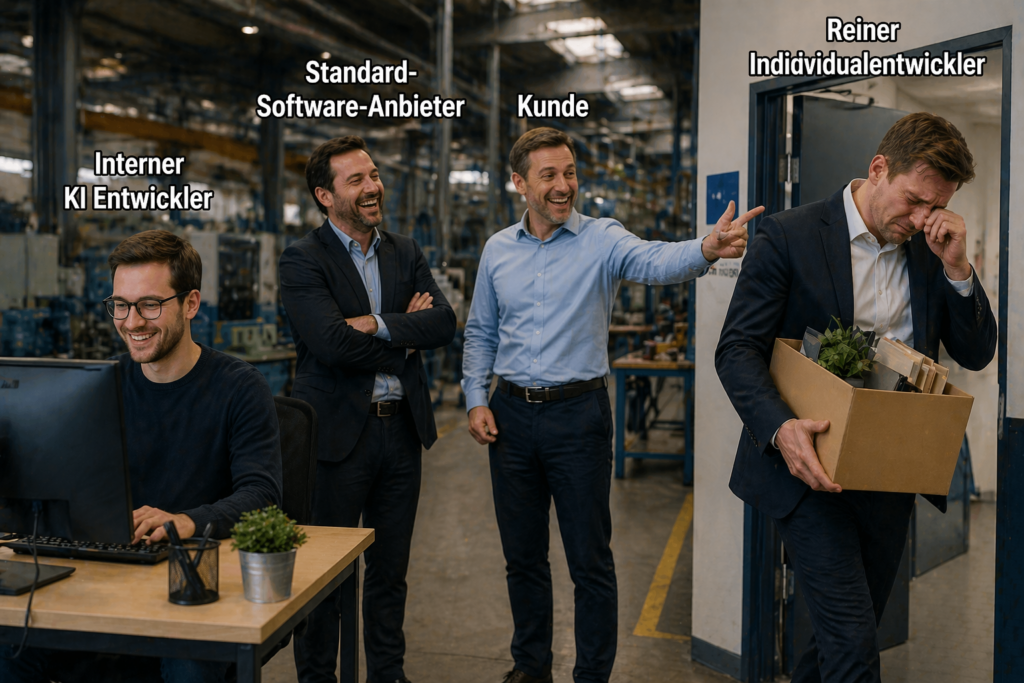
Farewell to pure custom development
Who benefits—and who should be cautious
The winners of this development
Mid-sized companies are perhaps the biggest beneficiaries. They often had neither the budget for true custom development nor the flexibility to be truly satisfied with standard ERP systems. AI-based development gives them access to custom solutions at prices that remain within budget for the first time.
Departments in large enterprises regain autonomy. Those who previously had to wait months for the IT department to get an internal tool can now prototype initial versions themselves with a good prompt and an AI-supported low-code tool—and then bring these to production readiness together with IT.
The Opportunity
Development teams that understand AI as an amplifier of their work can achieve greater impact with a smaller crew—and focus on architectural and strategic decisions instead of mechanical code generation.
Do not forget the risks!
Caution
AI-generated code must be understood, reviewed, and maintained. “Vibe coding” without understanding the underlying architecture leads to fragile systems and uncontrollable technical debt—just faster than before.
IT governance and security remain critical topics. With lower barriers to entry for custom development, the risk of shadow IT, poorly secured custom developments, and lack of compliance increases. Companies that want to actively shape this transformation need clear frameworks for who may develop what—and how these developments are integrated into the existing system landscape.
Also, the quality question remains real. AI assistants do not produce error-free software. They accelerate development but do not eliminate the need for testing, code reviews, and well-thought-out architectures—they only change how these activities take place.
Not to mention the legal issues, because the questions: “Who owns the code” or “Who is liable for errors in AI-generated software” should not be underestimated.
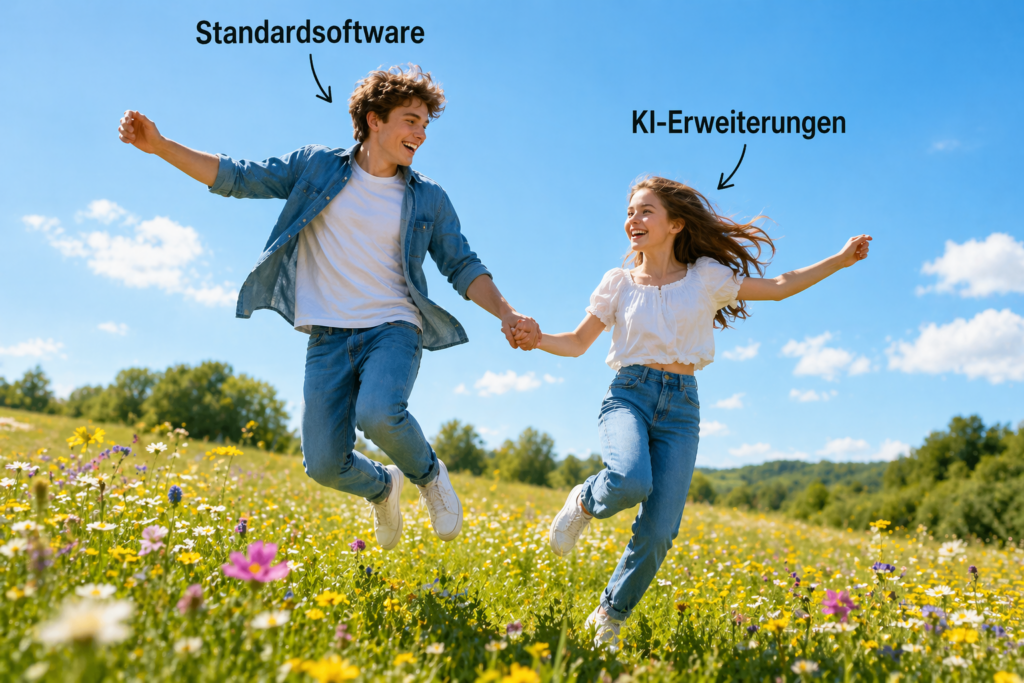
The possible, bright future
What this means for the future
The software landscape of the next five years will change more than that of the last twenty. We are moving away from the binary choice between “buy standard solution” and “commission custom development” toward a spectrum of intelligent, hybrid solutions.
Software vendors will increasingly build AI-supported extension and configuration capabilities into their platforms. The term “no-code/low-code” will be supplemented or replaced by “AI-code.” Developer roles are transforming: away from the traditional coder, toward the software architect, AI trainer, and quality assurance specialist.
“The question is no longer: Buy or build? But rather: What do we build ourselves and how do we use AI to do it faster, better, and cheaper than ever before?”
Companies that begin building AI-supported development competencies today, internally or through partnerships with modern service providers, gain an advantage that will translate into genuine competitive differentiation within a few years.
Schedule your appointment now and gain clarity. Here in the link. https://www.der-digitalisierungsberater.de/terminvereinbarung/
Always be the first to receive the latest news, interviews, and expert articles?
Conclusion:
Through this development, more and more performance will again be delivered “in-house” and the relevance of companies that generate their revenue from pure custom development will become increasingly less relevant.
Traditional custom development is dead. But its successor: agile, AI-accelerated, hybrid, and democratized is more vibrant than ever. And that is exceptionally good news.
Image source: ChatGPT