
Or when volume causes quality to suffer among software vendors’ project managers
Implementing an Enterprise Resource Planning (ERP) system—like other solutions—is a complex undertaking that requires well-thought-out planning and coordination.
Project managers, especially those working for software vendors and responsible for managing multiple ERP implementation projects, face unique challenges.
There is no fixed rule or exact number for how many projects a project manager can efficiently lead during an ERP implementation, as project complexity and scope, as well as the project manager’s capabilities, all play a role.
Ultimately, however, one rule always applies: the more projects, the more likely the project manager will fail—and potentially the individual projects as well.
In this blog post, we look at the topic in detail and also provide a few sample calculations that can help you determine whether the project manager is overworked.

An apple for the project manager and mentor is only given when everything runs smoothly
Here are some factors that should be considered when determining the appropriate number of projects:
Project complexity
The more complex the projects, the more attention and resources they require. Projects with many technical challenges, integration aspects, or extensive customizations may demand more time and energy from the project manager.
Example: Implementing “only” financial accounting in an ERP project is usually less complex than turning an entire company upside down by rolling out the new solution across all business areas—and not simply “making the old new again”, but truly digitally transforming the company. (new paint on an old car)
Complexity also includes topics such as integrating third-party systems, additional locations—especially abroad—whether the pure standard can be used, etc.
Project duration
The length of the project timeline matters. Project managers may be able to lead several shorter projects at the same time, while long-running projects may require more focus.
Example: A project that lasts only 6 months is certainly less complex than one that lasts 18 months—especially because longer projects also require you to deal with potential necessary changes that arise in a dynamic business environment.
In addition, long projects carry the risk of losing focus and motivation.
Resource availability
The availability of qualified team members and other resources affects the project manager’s workload. If sufficient resources are available, the project manager may be able to handle multiple projects.
Example: Given the current situation regarding availability, project managers tend to plan as rigidly as possible. But if employees then fall ill or leave the company, a planning model cast in concrete and built around availability quickly collapses.
If several projects are affected at the same time, things become particularly critical.
(See also “Project management tools” further down.)

Digital transformation projects are complex. Only with the right project manager who has sufficient time and expertise will you reach your goal
Always be the first to receive the latest news, interviews, and expert articles?
Team structure
An experienced, well-coordinated team can reduce the burden on the project manager. A well-coordinated team can work more independently and may require less intensive oversight.
Example: Industry-focused teams are always best. Those who have often worked together can hopefully do it better than a group of newcomers where everyone still has to prove themselves. Roles and responsibilities are often clearer, too.
Project management tools
Using effective project management tools can make it easier to organize and keep track of multiple projects. These tools help project managers manage tasks, milestones, and resources more effectively.
Example: Far too often, “the shoemaker’s children still have the worst shoes.” In other words, they sell you project management and digitalization tools, but do not use them themselves—or use them only minimally or very rudimentarily. It sounds strange, but it is true. Only with the right tools can a project manager efficiently lead multiple projects.
These tools should cover topics such as task management, documentation, project planning, cost and schedule controlling, etc. MS Excel®, Outlook® and the like are not good alternatives.
(See also my blog post https://blog.der-digitalisierungsberater.de/aufgabenmanagement-excel-outlook/)
Delegation instead of doing everything yourself
Unfortunately, many project managers are also “micromanagers.” No one can do anything right in their eyes; you have to decide everything and, if necessary, do it yourself. Only you have the experience, and you have to determine things—after all, only you are responsible.
Anyone who thinks like that has a problem. And the more projects they have, the more problems there will be. That is when you need to let go and delegate. Not so easy for some project managers.
Example: If a project manager realizes it is becoming too much, they should look at which tasks they can delegate to whom. Motivation is one of the most important criteria, because the person receiving the delegated task must understand why and be willing to take it on. “par ordre du mufti” works too, but it is far from ideal.

Learning how to share and distribute work
Communication and conflict culture
The project manager’s ability to communicate effectively is crucial. The better communication works within the team, the more projects a project manager can coordinate.
Human aspects must always be taken into account as well.
Example: A problem arises in the project. Now it is up to the project manager to intervene in the right way—neither playing the boss nor letting everyone just carry on until everything escalates for good. “understand and lead” could be the motto here.
Only those who can respond to the people in the project appropriately and have communication under control within the right culture are able to lead a project successfully.
By the way, a project also includes the occasional argument. A good project manager then gets everyone back in the same boat—and the team keeps rowing!
Personal time management
The project manager’s ability to manage their own time efficiently plays a major role. Structured time management makes it possible to oversee multiple projects at the same time.
This also applies to the ability to correctly estimate and assess time and effort in advance.
Example: This is where the topic of project management tools comes into play again. Anyone who does not have cross-project time management and simply plans everything in Outlook is definitely overwhelmed with their scheduling.
Stress and workload
Too many projects can lead to stress and overload, which can impair the efficiency and quality of the projects. The project manager’s health and performance should not be neglected.
Example: Americans talk about “work hard and play hard” or “work-life balance.” However, these are usually just empty phrases. But if, as a project manager, you do not recognize yourself that it is becoming too much and you are not able to say “NO,” then it is your own fault. It sounds simple. That is just how it is.
Ego and dependency
Many project managers like it when people “need” them and there apparently is no one else who can do it. Especially when they are seen as a “brilliant project manager” who can make anything work. That may be good for the ego, but not for the project. The corporate culture mentioned below should then consider what the “reward systems” actually look like—systems that do not appeal to the individual’s ego.
Example: A project manager does not document many things publicly—or at all—because it is in their “head”, making everyone dependent on their head.
Passing knowledge on or training new colleagues is also not “their thing.”
That is one way to make yourself seem important, but overall it harms the project.
Corporate culture
The company’s work culture and support for project managers also influence how many projects can be led efficiently. If the organization has a culture of support and provides resources, a project manager may be able to lead more projects successfully.
Example: If management wants to generate revenue at all costs and believes “we’ll sort it out somehow,” it will always be carried on the employees’ backs. Growth at any price is not really an option. If the head of consulting cannot see that this additional project will “be the last straw” for the project manager, then everyone has a problem.

Bet: With so many projects, neither the project manager nor the company has time management under control
A simple calculation example
Whether 2, 3, 5, or 10 projects—in this simple example, we show how to calculate availability and determine whether the assigned project manager is already working at or beyond their limit.
Ideally, you have already found out how many projects they are currently handling.
Just assume that project managers have never seen such a calculation—let alone done one. Somehow they have always managed to make it work… or not!
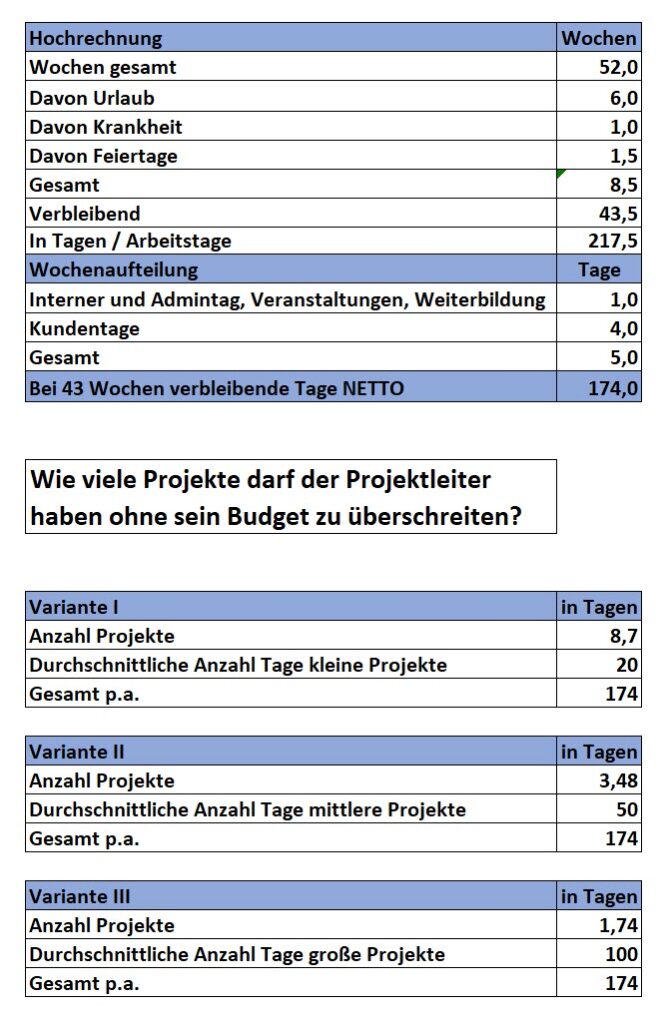
Sometimes even the software vendor could benefit from the “basic arithmetic” of resource control
Conclusion
The number of projects a project manager can lead efficiently during an ERP implementation varies and depends on a wide range of factors. It is important to find a balanced relationship between the number of projects and the quality of leadership to ensure a successful ERP implementation.
The specific circumstances of each project and the project manager’s strengths should be taken into account to determine the optimal number of projects.
If it is important to you to recognize early on when the project manager in your project is reaching their limits—or whether it cannot work from the outset—then simply book a free initial appointment with me.
For appointment requests click here for the link.
If the project manager says: “No problem,” you should think carefully about whether they are right.
Image sources: Unsplash