Risk factor: assumptions—why your digitalisation project could fail because of the “Schnitzel Paradox”
The paradox of due diligence
Imagine you are sitting in a restaurant you are visiting for the first time. Would you blindly trust the chef to match your taste exactly, use only the freshest ingredients, and have mastered their craft perfectly? Probably not.
Before you spend €15 on a schnitzel, you check the menu, read reviews, or at least take a critical look at the dishes on the neighbouring tables. You want clues. Indications. Evidence.
But as soon as those same people decide in the conference room on digitalisation projects, software rollouts, or multi-million-euro IT investments, that healthy scepticism suddenly seems to disappear.
“Does your schnitzel always taste equally good? No? So you are not willing to make an assumption in favour of a chef you do not even know? Yet in digitalisation projects, people do that all the time.”
That is exactly what the “Schnitzel Paradox” is about:
In private life, we insist on understandable information even for small expenses. But when it comes to strategic decisions with enormous impact, we often rely on assumptions, hearsay, and wishful thinking.
The problem: If you base decisions on well-meaning assumptions instead of solid facts, you risk not only budget overruns but, in the worst case, the future viability of the entire company.
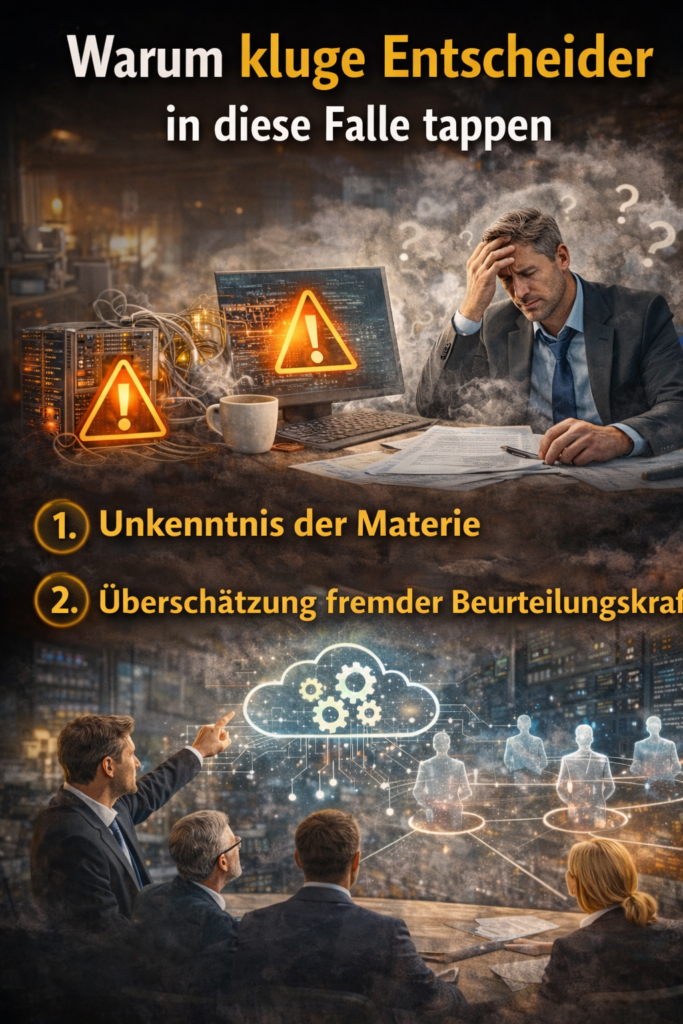
Why smart decision-makers fall into this trap
Why do even analytically minded and experienced executives keep ending up in this situation?
The cause usually lies in a dangerous combination of two factors:
1. Lack of subject-matter knowledge
Digitalisation is complex. Technologies, systems, interfaces, processes, and dependencies change rapidly. No one can have deep detailed knowledge in every area.
The real problem is not the lack of knowledge itself. It only becomes problematic when it is suppressed or glossed over. If you do not openly address a lack of clarity, you build decisions on an unstable foundation.
2. Overestimating other people’s judgement
To compensate for their own uncertainty, people often overvalue others’ assessments: those of service providers, consultants, internal project leads, or fellow executives.
In practice, this creates a dangerous vacuum of responsibility:
Everyone assumes someone else has already asked the critical questions, assessed the risks, and checked the facts.
In the end, the decision is not based on verified knowledge, but on a collective illusion:
Someone will know what they are doing.
The trap for smart decision-makers
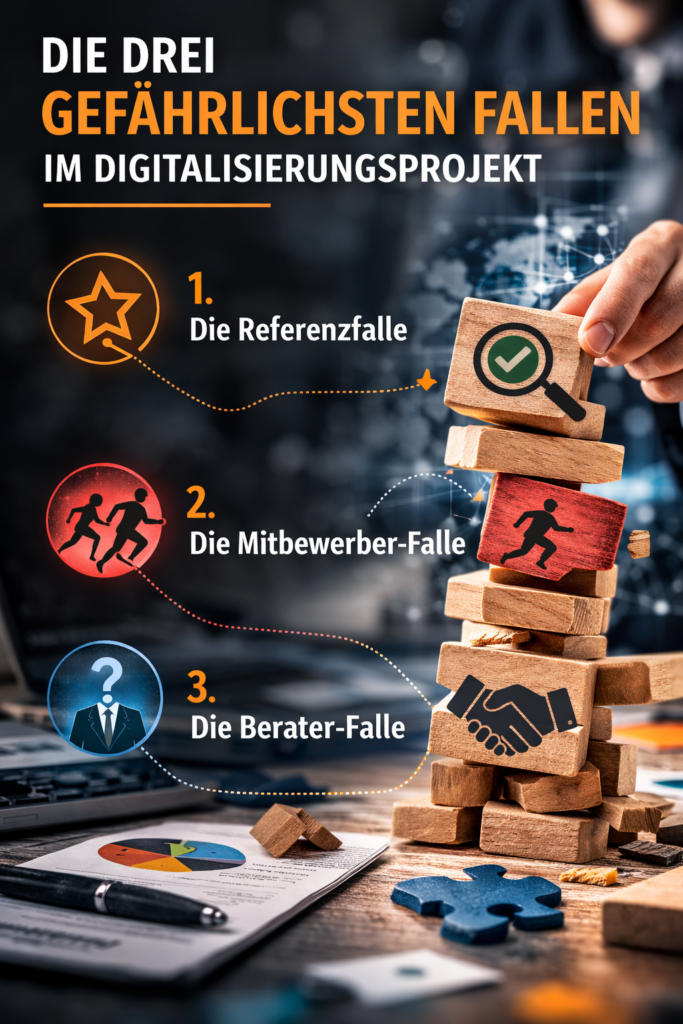
The three most dangerous assumption traps in digitalisation projects
In practice, this pattern shows up particularly often in three typical fallacies.
1. The reference trap
Many companies are convinced that a solution must be good because it is already being used successfully at another company.
The underlying assumption is: If it works there, it will work for us too.
That is a fallacy.
Because no company is an exact clone of another. Processes, system landscapes, responsibilities, data quality, corporate culture, and maturity level sometimes differ significantly. What led to success for a reference customer can cause major friction losses for you.
A reference can be a useful indicator. But it is never proof of transferability.
2. The competitor trap
Out of fear of falling behind, companies often orient themselves on their competitors’ behaviour.
The assumption behind it: The competitor will have made their decision based on hard facts.
But that is risky too.
Because as a rule, you do not know how carefully the competitor evaluated things, what internal problems there were, what special solutions were necessary, or whether the project is even considered a success internally.
If you copy uncritically, you may not be adopting the competitor’s success formula, but their mistakes.
Or put differently: In doubt, you are copying from someone who did not understand the solution themselves.
3. The consultant trap
External consultants, vendors, and implementation partners are important. They bring market overview, methodological expertise, and experience from other projects. That is precisely their value.
It becomes dangerous when this external expertise leads your own company to stop thinking critically.
The implicit assumption is:
The external experts know our operational reality well enough to make the right decisions for us.
But that is rarely the case.
Consultants know best practices.
However, they do not automatically know your company’s informal routines, long-established special cases, cultural friction, and operational constraints.
If you buy external knowledge without properly cross-checking internally, you are, figuratively speaking, consuming a “digital schnitzel” without knowing who is in the kitchen and what ingredients were actually used.
The 3 most important assumption traps
Why “experience” can become a risk factor in digitalisation
In decision-making processes, experience is often treated like a seal of approval. Anyone who has been active in the market for many years is automatically considered to have sound judgement.
But especially in digitalisation, this view is dangerously simplistic.
“Judgement is often based purely on experience—and therefore on assumptions.”
In stable, slowly changing environments, experience is a major advantage. In dynamic fields like digitalisation, however, it can also become a trap.
Because “experience” often means nothing more than repeatedly applying old patterns of thinking to new problems. Anyone who cites “20 years of experience” is often implicitly defending assumptions that were never properly verified.
Experience is only valuable if it is continuously tested against reality. Without consistent fact-checking, it quickly becomes routine with a claim to truth. And that is exactly what makes it dangerous.
In digitalisation projects, experience is therefore not a free pass; it is only an advantage when it is combined with openness, willingness to learn, and systematic verification.
The consequences: a black eye or total failure
When assumptions replace facts, wrong decisions are not the exception, but the logical consequence.
The impact usually shows up in two escalation levels:
The black eye
The project does not fail completely, but it becomes a never-ending construction site.
Typical consequences:
-
Budgets are exceeded significantly
-
Timelines slip repeatedly
-
Processes have to be artificially adapted to the software
-
Usability and acceptance suffer
-
Employees work with frustration and workarounds
In the end, the solution may work somehow—but only at the cost of high follow-up costs, operational inefficiency, and lasting dissatisfaction.
Total failure
In the worst case, the initiative fails completely.
Then:
-
Investments are written off
-
Project teams are demotivated
-
Operational processes are massively disrupted
-
Old systems or manual processes are reactivated
The project either gets tangled up in contradictions during development or, after go-live, blocks the company so severely that the only option is to roll it back.
Then it is not only the budget that is lost, but often also valuable time, trust, and strategic ability to act.

Just a black eye—or does nothing work at all in the end?
The way out: constructive scepticism instead of blind trust
The solution is not more generic workshops, more buzzwords, or more PowerPoint.
The solution is an attitude: constructive scepticism.
This does not mean talking everything down or slowing innovation. It means consistently testing statements, recommendations, and supposed best practices for their viability in your own context.
“Best practice” must not be the end of the discussion. It must be the beginning of careful scrutiny.
This includes uncomfortable but necessary questions such as:
-
What verifiable evidence do we have that this process works in our specific infrastructure?
-
What assumptions are we making silently right now?
-
Who has actually checked which facts?
-
Which risks are evidenced—and which are merely assumed?
-
Where are we relying on experience even though we actually need evidence?
These kinds of questions do not slow decisions down unnecessarily. They prevent costly wrong decisions.

Trust is good; control is better!
Always be the first to receive the latest news, interviews, and expert articles?
Conclusion: Do not blindly trust the chef
The “Schnitzel Paradox” highlights a widespread problem in digitalisation projects:
Companies often make decisions with enormous impact based on assumptions that were never properly checked.
People trust references, copy competitors, rely on consultants, or mistake experience for truth. The result is projects that become too expensive, too slow, too complex, or completely unusable.
If you want to shape digitalisation successfully, you need more than technology and project plans. You need sound judgement. And that does not come from habit or authority, but from facts, contextual understanding, and critical thinking.
So approach your next major project with the same caution as an unfamiliar dish in a foreign restaurant:
Do not blindly trust the chef. Check the ingredients.
Further ideas and resources can be found at www.der-digitalisierungsberater.de as well as in the specialist book “Digitalisation in Industry, Retail and Logistics”.
In the end, the key question is:
When was the last time you made a million-euro decision simply because you assumed someone else would already have checked the facts?
Image source: ChatGPT