Can AI already replace the digitalization consultant?
At first glance, Artificial Intelligence appears omniscient. But is it really?
What used to be “Googled” is now simply entered into ChatGPT. More and more people rely on AI’s answers – often without questioning how they are generated.
Many have long known: The quality of the results largely depends on the right question – and the right AI.
I personally tested how helpful an AI is in selecting a new digitalization solution. The result? Both sobering – and instructive.
It became clear to me: Without an experienced consultant, it’s (still) not possible.
In the current blog post, I explain why this is the case – and what risks arise if one blindly relies on AI.

AI vs. Consultant in the Project. Is there a winner?
(drawn by ChatGPT)

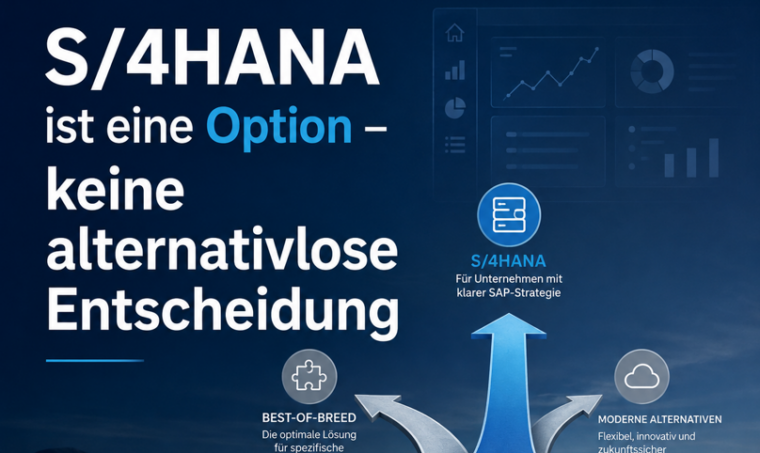
With the variety of offerings, “customers often can’t see the wood for the trees”!
(drawn by ChatGPT)
Always be the first to receive the latest news, interviews, and expert articles?
When NI (Natural Intelligence) is still far superior to AI
There is a problem with AI, because AI needs data to learn. This includes data that tells the AI which data is useful for the learning process.
The examples mentioned above clearly show that an “unsupervised” AI, which simply draws from the internet, does more harm than good.
Furthermore, AI lacks one thing: LIVE experience. From projects, from implementation, from discussions, and from very personal analyses.
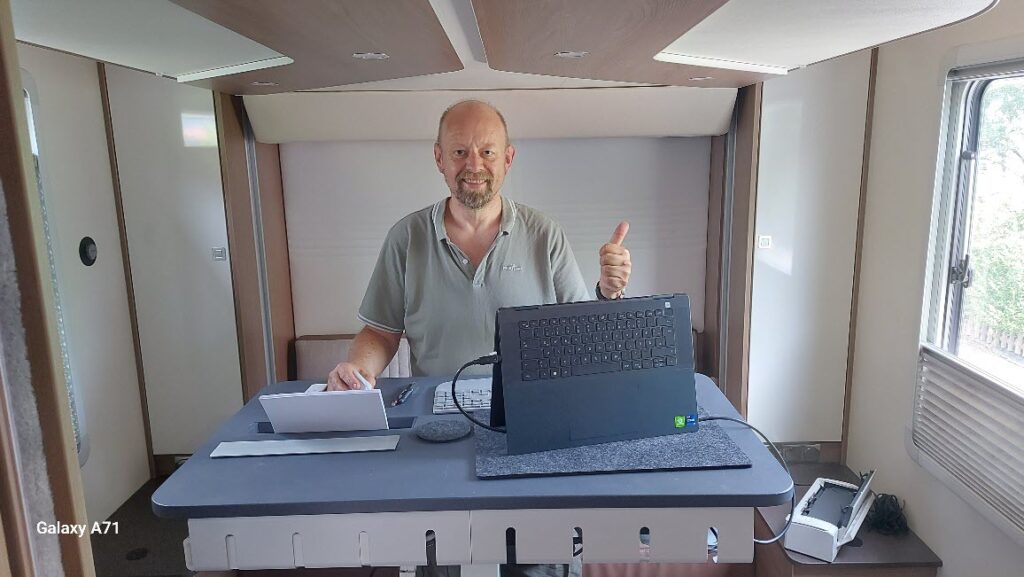
As long as these are not digitally recorded anywhere, but for example in the consultant’s brain (as in my case), the consultant is always and everywhere superior to AI in precisely these areas!

No, I won’t let AI tap into my brain
(drawn by ChatGPT)
And what are examples of relevant experiences?
The know-how of a long-standing consultant usually represents the decisive added value compared to pure AI support.
These cannot be found in any review portal or database on the internet from which AI can learn.
Here are some examples:
- Relevant contacts
- Knowledge of “good and bad” salespeople and consultants
- Pitfalls of marketing vs. real life – promises vs. implementation
- Quality of presentations, workshops, etc.
- Quality of contracts
- Willingness to negotiate
- Efficiency of the implementation methodology
- Handling of problems
- and much more.

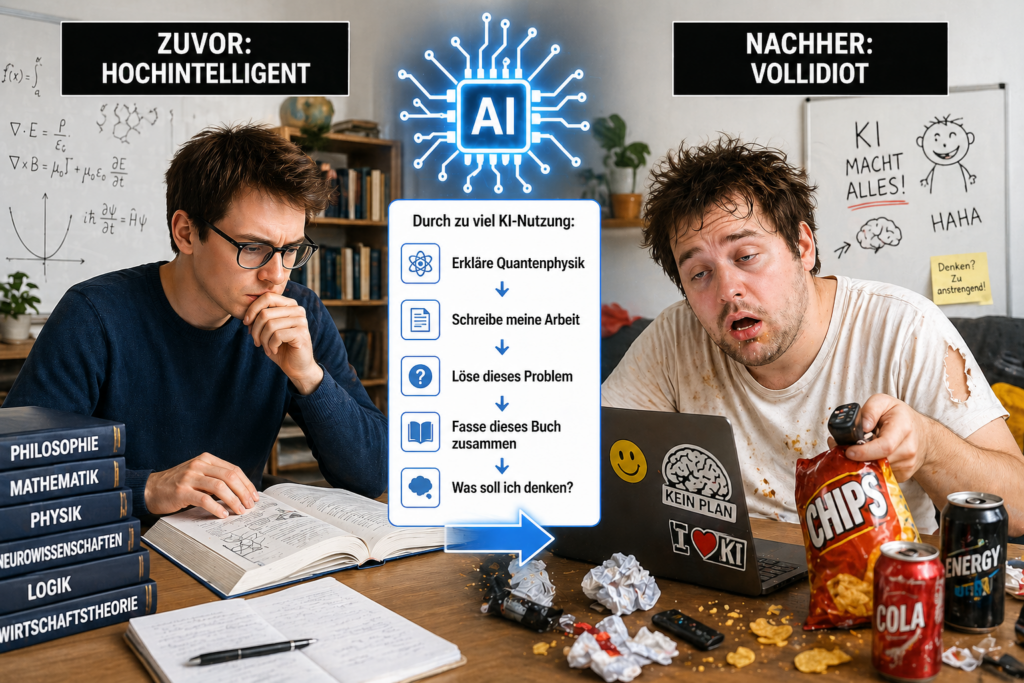
As a “one-eyed man among the blind,” you won’t win a trophy!
(drawn by ChatGPT)
Successful digitalization projects are only possible with the right consultant!
If you want to know how that works and if we are a good fit, feel free to arrange a free initial consultation.
To schedule a free initial consultation, simply request an appointment here via the link. It will certainly be worthwhile!
Conclusion: Brain, heart, and intuition cannot yet be replaced by AI. True to the motto “Beware of the trap,” the consultant is currently still part of the formula for success!
P.S. Perhaps I used the wrong AI. However, ChatGPT could not, or would not, recommend a “better” one for this purpose.
Image sources: ChatGPT