Living and working environmentally conscious – that works particularly well here
Okay, I admit it, my ego has reached a peak regarding environmental friendliness with today’s post.
When I set out to gain more freedom, to be closer to nature, and to bid farewell to city dwellers and their negative attitude towards life and their fellow human beings, the topic of environmentally friendly living was not a particular goal at all.
Of course, those who have less can also consume less. Regardless of the area. It has long been clear to me that the fear-mongering CO₂ evangelists are not one thing: in optimal harmony with nature as a whole.
From my perspective, the CO₂ footprint is complete nonsense, as it in no way reflects humanity’s overall interaction with nature. However, it is certainly sufficient as a basis for fear-mongering, and also as a basis for restricting the lives and work of people on this Earth.
And while those who lecture us drive around in their fat cars, fly around the world in their private jets, and travel the world on their monstrous yachts, we are all responsible for creating our own environmental balance, not a climate balance. Because one cannot exist without the other.
Those who clear forests to build wind turbines with huge concrete foundations that seal the soil (including the access roads), with extremely toxic gases and materials that are not recycled; those who build electric cars that destroy nature during the extraction of rare earths and support child and slave labor; those who seal huge areas with solar panels in nature; those who advocate for heat pump laws that lead to the creeping expropriation of people, and much more – they have no right to dictate how I should live in harmony with nature.
Even though I have only been living my life in my consulting mobile on a campsite, in the middle of the forest, in the Palatinate for 6 months, I have already learned and implemented so much to give my personal harmony with nature a whole new meaning.
In this blog post, I describe my path to more environmental AND nature conservation. Perhaps it will inspire one or the other to change something in their own attitude and thus in their own life, and to rethink the view on CO₂ and climate fear-mongering. Because it is possible. And it is also very fulfilling at the same time!
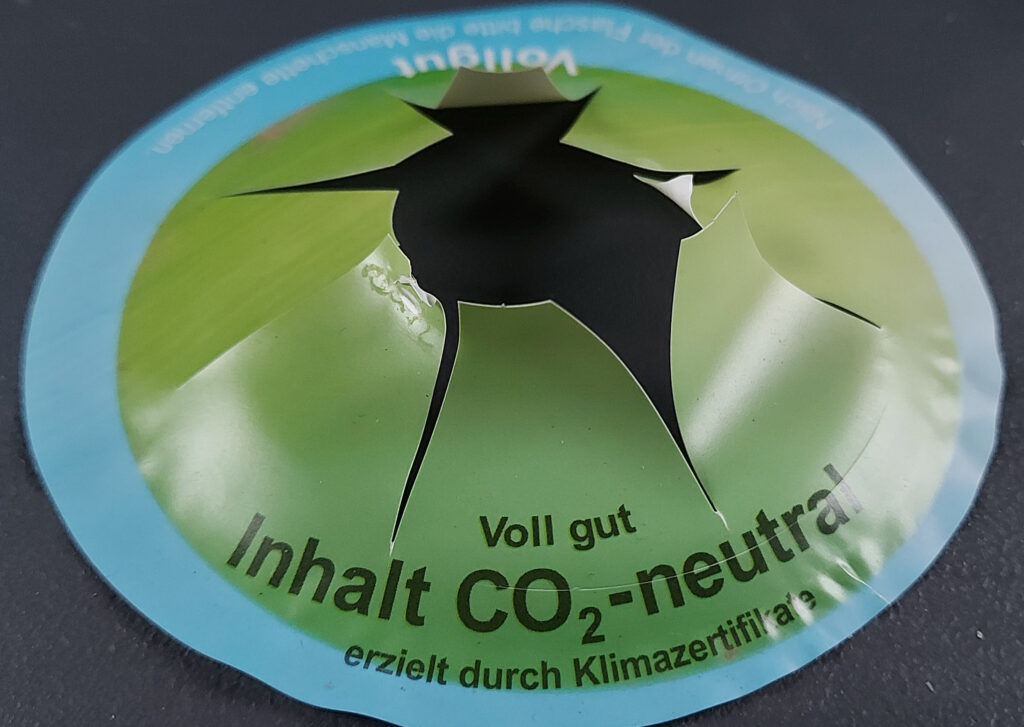
My propane gas is CO₂-neutral. (Purchased, so ONLY money-making)
Laundry, completely environmentally friendly
Detergents, fabric softeners, descalers. All pure poison for the environment and for our bodies. Is it any wonder that one gets allergies and rashes? One shouldn’t be.
Because it can be done completely differently:
- Laundry ball instead of detergent
- Vinegar instead of fabric softener
The communal industrial washing machine
I always wondered why the wash cycle or dryer took so long. Washing machines and dryers, like those found in a laundromat, are much more efficient. The cycles are much faster, without compromising the quality of the washing and drying process.
Furthermore, I had no acquisition costs. (Dryer and washing machine approx. €2,000 for quality appliances) At €2 for a wash and €1 for a dryer load, I can wash 750 times and dry 500 times.
Since I have much less clothing (available space), washing once a week is currently sufficient for me. This means I can do laundry for 14 years without investment. Hardly any new washing machine lasts that long today.
In summer, I dry the laundry outside anyway. That costs nothing at all.
Oh, and if I want some fragrance in my laundry, a few drops of essential oils on the laundry ball are enough. No fabric softener can compete with that.

It can be done differently, much cheaper, just as clean, and environmentally friendly.
Washing dishes and water in general
If you have few dishes (for 4 people) and are mostly traveling alone, you don’t really have many dishes. The luxury of a dishwasher is not available here. Why would it be? You just go to the washhouse with the washing-up bowl and do the dishes there.
Often you’re not alone then and can have a chat or two. And? Who among you gets into conversation with neighbors at the dishwasher? No one!
Drinking water
During a recent drinking water test for PPM (Parts per Million), I found that we have extremely good water here. It apparently comes from a spring. Because with 59 ppm from the tap in the laundry room, the water here has the quality of super spring water. (I will have a detailed water test done later)
My water consumption
Since direct water consumption in the motorhome is limited to cooking, drinking, and brushing teeth (showering, washing, dishwashing, large toilet use in the washhouse), my water consumption is extremely low.
And for the toilet, I don’t need water for the “small business” either, as I have a dry composting toilet.
I only need to refill my 120-liter tank approximately every 4 weeks. In summer with the hose and in winter with the water can.
No winter water on site
Unfortunately, I have to admit this disadvantage. Not all pitches on our campsite have what is called winter water. This means that in winter I either have to lay a long hose to the washhouse or walk back and forth several times with my 10-liter water can.
But, what the heck, a little exercise is good too.
But what the heck. I’ll survive that too. Besides, exercise, even in the cold, is good.

In winter, water only goes from the can into the tank.
Heating with very little energy
How much heating do you actually need? Little, especially if the area you need to heat is also very small.
It’s practical if you can rely on various heating options.
In my blog post on the topic, I explained exactly why and how my decision for selecting the right heating system was made.
Meanwhile, I’ve also got the “hook out”. Because the petroleum heater is used as a “booster heater” during the day and in the evening (so it’s not permanently on), and at night the gas heater maintains a temperature of 15°C. That’s enough when you’re lying in a cozy bed.
With this method, for example, 5 liters of petroleum per week are sufficient for me. Due to the favorable purchase in France, that’s only €33 to €40 per month for petroleum.
The option for electric heating is really only intended for emergencies, because at the current €0.60 per KW, it would be very expensive here. But an emergency plan is always good if you don’t want to freeze.

The thermal curtain and additional winter insulation help keep the temperature cozy and warm
To shower, head to the shower house
I know, how can one? Well, it’s possible because we are lucky enough to have very nice facilities here. And I have the advantage that the shower house is only about 50 meters from my pitch. So you can manage even in winter without freezing.
By the way, in winter the large shower house is locked, and you then get access to 2 disabled-friendly showers/toilets. This allows the campsite to save enormous heating costs in winter. It protects the environment and also your wallet.
And yes, I have a pleasantly large shower in the motorhome. But why heat the water here and then have to clean the whole thing, when I can go to the warm washhouse for €1.
By the way, when showering, you are automatically encouraged to save, because after a while, time is up. In an apartment, certainly much more water goes down the drain before you’re done.

Wellness in a completely different way
Always be the first to receive the latest news, interviews, and expert articles?
My chemical-free household!
How many different cleaning products do you actually have under your sink or in your cupboard? 10, 12, or even more concoctions?
What would you say if everything could be done with just 2 basic cleaning agents? In addition, there’s gall soap and citric acid.
I probably wouldn’t emphasize the topic of “healthy digitalization” (see blog post) so much if it weren’t also based on the highly praised and effective essential oils I use. Through various mixing ratios, one can create different agents like dish soap or
For stains and the like, there is also gall soap for pre-treatment, for example, when washing.
By the way: even cleaning the exterior of the consulting mobile is completely chemical-free. Okay, then it’s a total of 3 agents.
But you certainly have to admit that you can hardly keep up, right?

Cleaning also works without chemical cocktails
Electricity – not just from the socket
In my entire life, I have never consumed so little electricity as today. No wonder, because how much do you need in a motorhome? The sheer number of sockets and the space for all possible electrical appliances make high consumption impossible in the first place.
My current estimate for monthly electricity consumption is approximately 80 KW. Projected annually, that’s only about 1,000 KW per year.
In the summer months, when the sun shines, two 110-watt solar panels on the roof currently allow me to be completely self-sufficient from “shore power” for up to a week. I wouldn’t have thought that.
By the way, my refrigerator runs very economically on gas. Summer and winter.
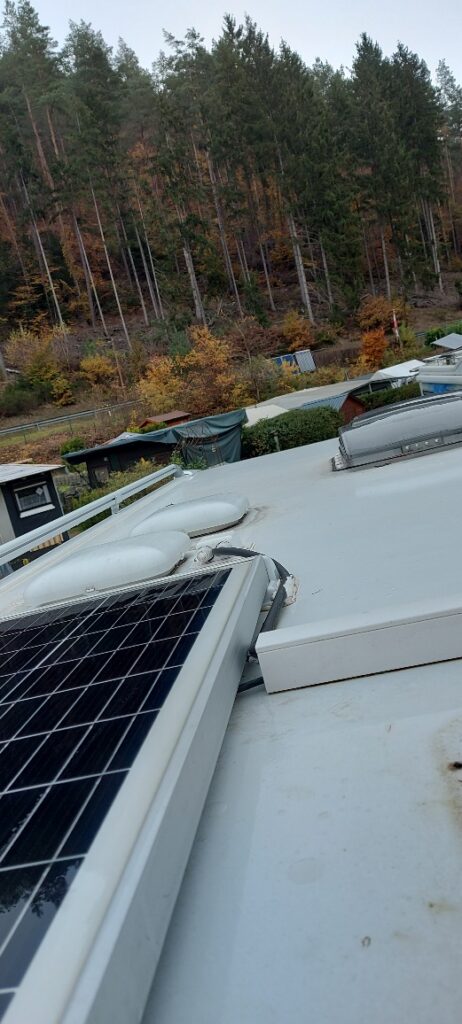
My motorhome from above. There’s still room for solar panels
Further actions and plans
Do you know the saying “everything has an end, only a sausage has two”? The end of the line regarding self-sufficient energy generation and resource saving is still a long way off.
I still have the following plans; the first has already been implemented, and more will follow.
Insulation and Co.
I have laid an outer dike under my vehicle. This already provides some insulation against the rising cold in winter from the concrete blocks.
Next, inflatable air hoses will be placed under the motorhome to act as a wind barrier. It can get very windy here. Despite the double floor in the consulting mobile, a constant draft under the vehicle would contribute to cooling. If this is prevented, a “partially insulated” air layer will form under the vehicle.
The roof windows, like the windows in general, are a small problem because, although they are sealed, they do not have particularly good insulation properties. Therefore, I will insulate the roof windows with additional foam mats, making sure that no condensation forms there.
In winter, I don’t need to open the roof windows or look out of them anyway, and the insulation is not visible behind the cover.
Inside the vehicle, the laid carpet also helps and creates a homely feeling when walking (which I also like to do barefoot in winter).
The cab will also soon be fitted with external insulation. This can be folded down on the window during the day so it’s not too dark and causes less condensation because it’s fitted externally.
Energy generation
Solar energy, especially in summer, is the option to be supplied with electricity as 100% self-sufficiently as possible. My two 110-watt solar panels on the roof and a 480Ah battery (approx. 6 kW) already help immensely. To become even more self-sufficient, I want to increase the capacity on the roof by adding two more solar panels and a mobile panel with 480 watts and an expandable, mobile 1 kW battery.
Only the combination of energy generation with sufficient storage helps to get through rainy days. In winter, however, I am still dependent on shore power.
Conclusion:
The combination of a sensible energy mix, the use of communal facilities, and alternative cleaning products for body, clothing, and the consulting mobile makes not only me a winner.
Everyone wins: the environment, my wallet, and even my health
I wouldn’t have thought that before. And I will continue to work on increasing my self-sufficiency and my environmental footprint even further. And what are you doing?
There are ONLY winners with my lifestyle as a mobile digitalization consultant
Image sources: internal