
Are We Making Ourselves Obsolete Again?
Technological progress has experienced rapid development in recent decades. Robots and artificial intelligence (AI) have long since ceased to be mere science fiction and have found their way into many areas of our lives. Robots are also causing a stir in sports, raising the question of whether they will replace humans as athletes in the future.
In this blog article, we take a look at current developments as well as the ethical aspects of this topic.
Watch and be amazed!
The Arrival of Robots in Sports
The use of robots in sports is not new. Automated systems have been used in various sports for years. Examples include ball machines in tennis that serve precise balls in continuous loops, or artificial referees in table tennis that monitor the playing surface via sensors. However, recent technological advances have expanded the possibilities and are raising new questions.
This is best seen live and in color in the video here in the post. Not only does the human stand no chance against the robot, but even the self-important arrogance of a winner has been provided for through appropriate programming.
At first glance, this seems to amuse many. But the saying “he who laughs last, laughs best” applies here too. And a robot can certainly laugh by now!
Always be the first to receive the latest news, interviews, and expert articles?
Supposed Advantages of Robot Technology in Sports
The use of robots in sports brings several advantages. One of the most obvious is the precision and consistency that robots offer in their execution. In sports such as golf or archery, robots could provide a consistent swing or precise shots. Through these capabilities, they could assist athletes in improving their technique by analyzing and optimizing movements.
Replacing them, however, is a completely different story.
Another difference is that robots do not fatigue the human body. They can deliver constant performance over long periods, which could be of great benefit in sports such as marathons or cycling races. This could allow for new records to be set and boundaries to be pushed further.
That’s all well and good, but against technical development and progress, we humans are already the “cripples” compared to the “all-rounders.”
This also raises the question of whether we want to measure ourselves against records set by machines. Probably not.

Transhumanism: Just install an upgrade. But what happens then?
Disadvantages and Ethical Concerns
It is no wonder that there are so many disadvantages and ethical concerns for humans associated with the use of robots in sports. A central point is the question of fairness and equal opportunity. If robots are used in certain sports and can deliver superhuman performance, this will distort competition, and human athletes will soon be viewed as “inferior carbon objects.”
Another aspect concerns the human component of sports. Sporting events attract people from all over the world who identify with the athletes and experience their emotions. The use of robots could impair the emotional connection between athlete and spectator and reduce the attractiveness of the sport.
Unless humans retreat to the spectator stands and leave the competition to engineers, developers, technicians, and artificial intelligence.
In the true sense of the word, that would no longer have anything to do with sports.
“Half and half”—even if we’re not talking about dumplings, but about transhumanism
However, a simple yes or no can very easily become a “MAYBE,” because the integration of technical implants or even chips to increase performance is certainly far more likely when looking at short- and medium-term goals.
Who can guarantee that the person facing you in a competition hasn’t already had a few “minor” modifications made?
What sounds utopian is ultimately already a reality. Just ask Elon Musk or indulge in the dystopian fantasies of a Klaus Schwab from the WeForum, who sees transhumanism as the future of humanity. Unfortunately, not just for the improvement of human performance. But that is a completely different, albeit interesting, topic.
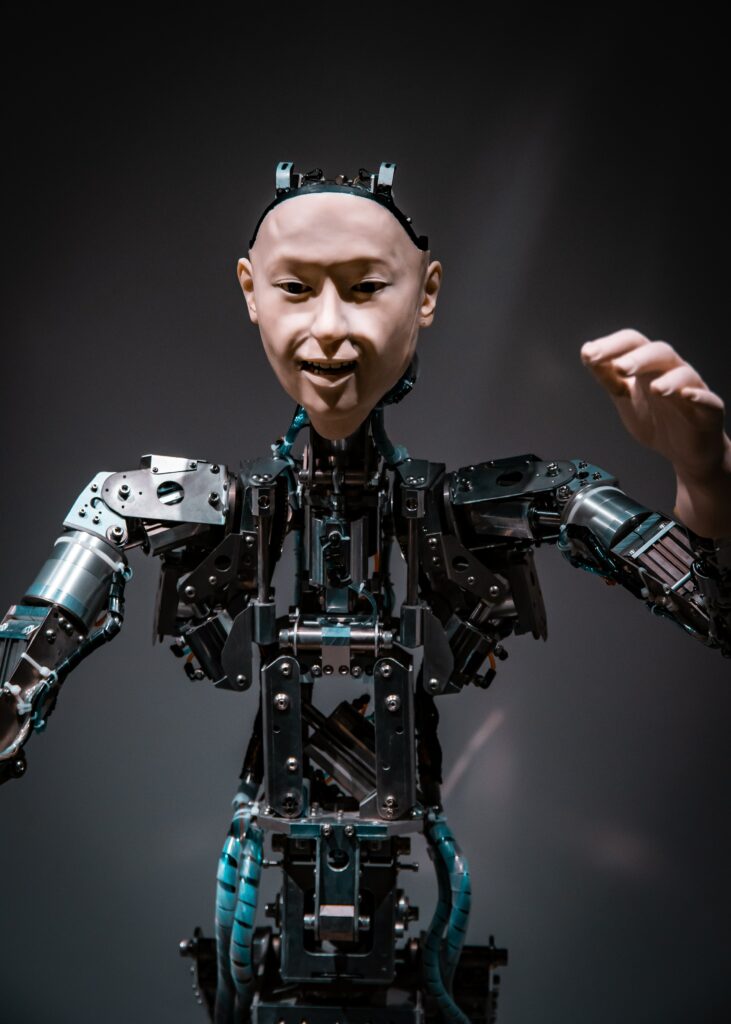
Are they already among us? Can we still recognize them? This one, yes.
The Question of “Recognition”
In the video shown here, it is very easy to see who is the human and who is the robot. But for how much longer? When will technology not only play perfectly but also be able to replicate humans so perfectly that technical aids are needed to identify who is who?
Future Outlook
We are currently still at the beginning of the development of robot technologies in sports.
They will replace humans when competition relates purely to performance and the generation of revenue from the spectator stands, which is not at all unlikely.
Conclusion
The debate over the use of robots in sports is complex and touches on many ethical questions. The technology undoubtedly offers great potential, but it is important to carefully evaluate the impact on sports and society.
The future will show how the integration of robots and artificial intelligence changes sports.
That is why one must ask the question: “Will the fascination of human competition be replaced by the fascination of technological competition?”
If you enjoy my blog posts and would like to utilize my expertise in your digitalization project, simply schedule a free initial consultation with me.
Food for thought: Robots in sports, following the assimilation concepts of the Borg (Star Trek)

Fooled you: The video is actually a fake! Click here for the article and video comparison. Which, however, raises the question of what is even real anymore? Only what we can see and touch directly in front of us?
The questions asked previously are nevertheless justified and should give everyone pause for thought!
Image sources: shutterstock Video source: YouTube